 Home Page
 Home Page

 Share to Twitter
 Share to Linked In
Download PDF version here: The Role of Technology in Today’s SNF Onsite Ancillary Care
Dental, vision, hearing, and foot care are important services in skilled nursing facilities (SNF). Many SNFs have turned to external firms to deliver ancillary care onsite. It is a proven model that alleviates a host of pressures: staffing constraints, compliance requirements, and the transportation difficulties for residents and staff to offsite medical offices.
Technology plays a central role in onsite ancillary care delivery. This article highlights four principal benefits generated by the set of technologies in broad use today.
The Need for Ancillary Care
Beyond specific regulatory requirements, the rationale for SNF focus on resident tooth, ear, eye, and foot conditions rests on multiple factors. Previous Aria Care Partners articles document three compelling care drivers (Figure 1): 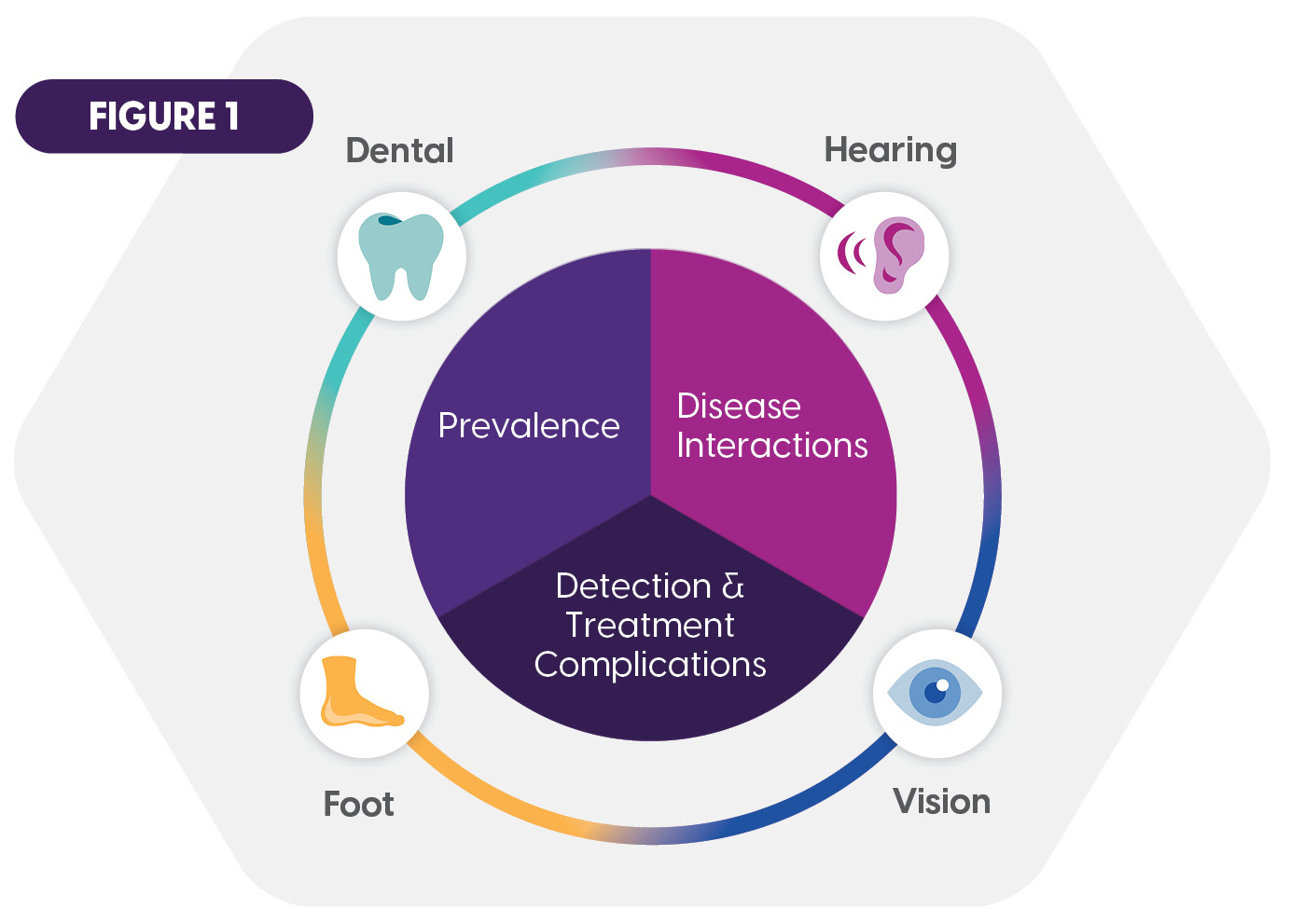
- These issues tend to be prevalent among the resident population.
- Communication difficulties and resident resistance sometimes complicate ancillary care diagnosis and treatment.
- Dental, hearing, vision, and foot problems have been linked to and interact with other serious diseases and illnesses.
How Technology Powers Effective Onsite Care
Addressing the range of ancillary care demands requires consistent onsite attention. Current and emerging technologies support caregivers in this effort and generate four vital benefits for today’s SNF communities.
Enables comprehensive and versatile care
Onsite medical professionals rely on various technologies to perform evaluations, checkups, monitoring, and treatments. Dental, vision, hearing, and foot care all use a set of discipline-specific, transportable care equipment and instrumentation. To take just the dental example:
- Portable x-ray machines that capture quality dental images.
- Dental delivery units with self-contained suction and high-speed tools. Recent advances have made these mobile units much smaller, lighter, and more versatile.
- 3D printing technology to produce custom dentures and partials tailored precisely to the resident’s mouth.
- Electronic medical records that permit consistent and comprehensive documentation.
Produces more efficient care delivery
A typical onsite provider’s day involves seeing many residents. Devoting appropriate attention to each individual is important. Data analytics aid the efficient allocation of medical professionals’ time and resources and enhance reporting capabilities.
Further process streamlining derives from permission-based remote access to a facility’s system to obtain medical records in advance of a visit. Caregivers can prepare for and structure their days accordingly. Greater data accessibility also promotes acceleration and accuracy of care plans.
Remote patient monitoring technology assists both internal staff and external caregivers in active tracking of a resident’s health status. This promises to further speed diagnoses while helping ensure resident adherence with care regimens.
Helps personalize care and create positive experience
Residents present a range of medical issues. Some are not mobile or have significant hearing or vision loss. Today’s technology permits more personalized care to meet varying needs. For example, handheld vision screeners and portable autorefractors let onsite eye care professionals practice at the bedside if required.
Healthcare consumers expect use of the latest technology in their medical encounters, and SNF residents and their families often display curiosity about the new dental or podiatry equipment. Knowing that it is being deployed, even in the background, fosters confidence and trust. This contributes to a better overall experience.
Adapts to specific facility needs
SNF communities vary in physical layout, workflows, and policies. Unique constraints and pressures are often present. Mobile technology and instruments along with contemporary software tools grant significant flexibility to adapt onsite ancillary care to facility variations. Disruption to existing patterns is minimized, and the external services provider can function as an extension of the SNF staff.
Artificial intelligence in ancillary care
Artificial intelligence (AI) is a dominant topic in healthcare. Just 4.5% of nursing facilities were estimated to be AI adopters in 2025.1 However, uses and investment are ramping up rapidly. The market for AI in nursing-related administrative and clinical applications for long-term care facilities will double from current levels to reach $1.4 billion annually in 2033.2
With widespread deployment on the horizon, AI is poised to enhance and extend the advantages shaping long-term care. SNFs stand to gain significantly from the infrastructure and innovations created for service providers and patients.
Conclusion
The independent service firm option represents a cost-effective means to satisfy the growing demand for quality onsite ancillary care. Today’s dental, vision, hearing, and foot care is fully technology-enabled. SNFs are realizing many benefits from this technology, creating long-lasting value for their communities.